Aging with Disability in India: The Gap Nobody Is Planning For
India is growing older, and the need for assistive technology is growing with it. But what happens after someone receives a prosthesis, wheelchair or other assistive device? We need to start planning for a lifetime of support, not just one moment of need.
Key takeaways
- India’s population aged 60 and above is projected to reach 347 million by 2050.
- People ageing with disabilities may need changes to their assistive devices, rehabilitation and daily routines.
- Comfort, maintenance and ongoing clinical support matter alongside technological sophistication.
- Government, CSR and rehabilitation programmes should consider the full lifecycle of assistive technology.
- Long-term independence and quality of life deserve attention alongside employment outcomes.
India is getting older. Disability does not retire.
These two realities are moving towards each other, but we still often treat ageing and disability as separate problems.
I lost my right hand in 2018. I was young when it happened, and much of my journey involved figuring out how to regain independence, return to work and continue doing the things I enjoyed.
Those were important goals. They still are.
But there is a question I find myself thinking about more as someone who lives with limb loss and builds prosthetic technology.
What happens when a person with a disability grows old?
What happens when the prosthesis they could comfortably wear at 30 becomes difficult to use at 65?
What happens when their activities change, their physical abilities change, or they need additional training and support?
And perhaps the more difficult question: who supports them when returning to work is no longer the primary objective?
At Symbionic, we build assistive technology for people with upper-limb differences. That work has made me think about a much larger challenge.
I believe we need to stop treating assistive technology as a product delivered at one point in someone’s life and start treating it as part of a lifelong support system.
A device is a purchase. Support is a system.
India needs to start building that system.
The man I met on a train
I still remember the first time I met another amputee.
It was in a train compartment reserved for persons with disabilities, commonly called the Divyangjan coach. Ironically, the two of us were the only persons with disabilities there. The rest of the compartment was crowded with able-bodied passengers.
But that is a conversation about empathy and accessibility for another day.
The man was around 65, perhaps older. He had lost his arm in his twenties and had spent most of his life living with limb loss.
We started talking.
He told me that he had tried using a prosthetic hand many years ago, but it was heavy, uncomfortable and painful. Eventually, he gave up on it.
What struck me was that he had spent his entire working life without knowing that other solutions might exist.
He told me he had never interacted with another amputee or person with a disability. For decades, he had navigated his disability largely on his own.
He also carried a sense of guilt and shame about his disability.
When he spoke about his life, the one thing he was particularly proud of was that he had managed to work and provide for his family.
And that stayed with me.
Here was someone who had spent nearly four decades adapting, working and raising a family without the technology, information or community that might have made parts of his life easier.
He had done everything society expected of him. He had worked. He had provided. He had persevered.
But who had supported him?
What if his first prosthetic hand had been lighter and more comfortable?
What if someone had introduced him to other amputees who could share their experiences?
What if he had known that prosthetic technology had evolved, or that he could seek a different solution?
What if a rehabilitation system had continued supporting him beyond that first unsuccessful fitting?
I cannot say how differently his life would have turned out.
But I believe better technology, continued support, accessible information and a community of people who understood his experience could have made a meaningful difference to his quality of life.
That encounter changed how I thought about disability support.
We often celebrate people with disabilities for overcoming barriers. We spend far less time asking why they had to overcome so many barriers alone.
And as India’s population grows older, I worry that many more people could find themselves in a similar position.
India is ageing faster than our support systems are adapting
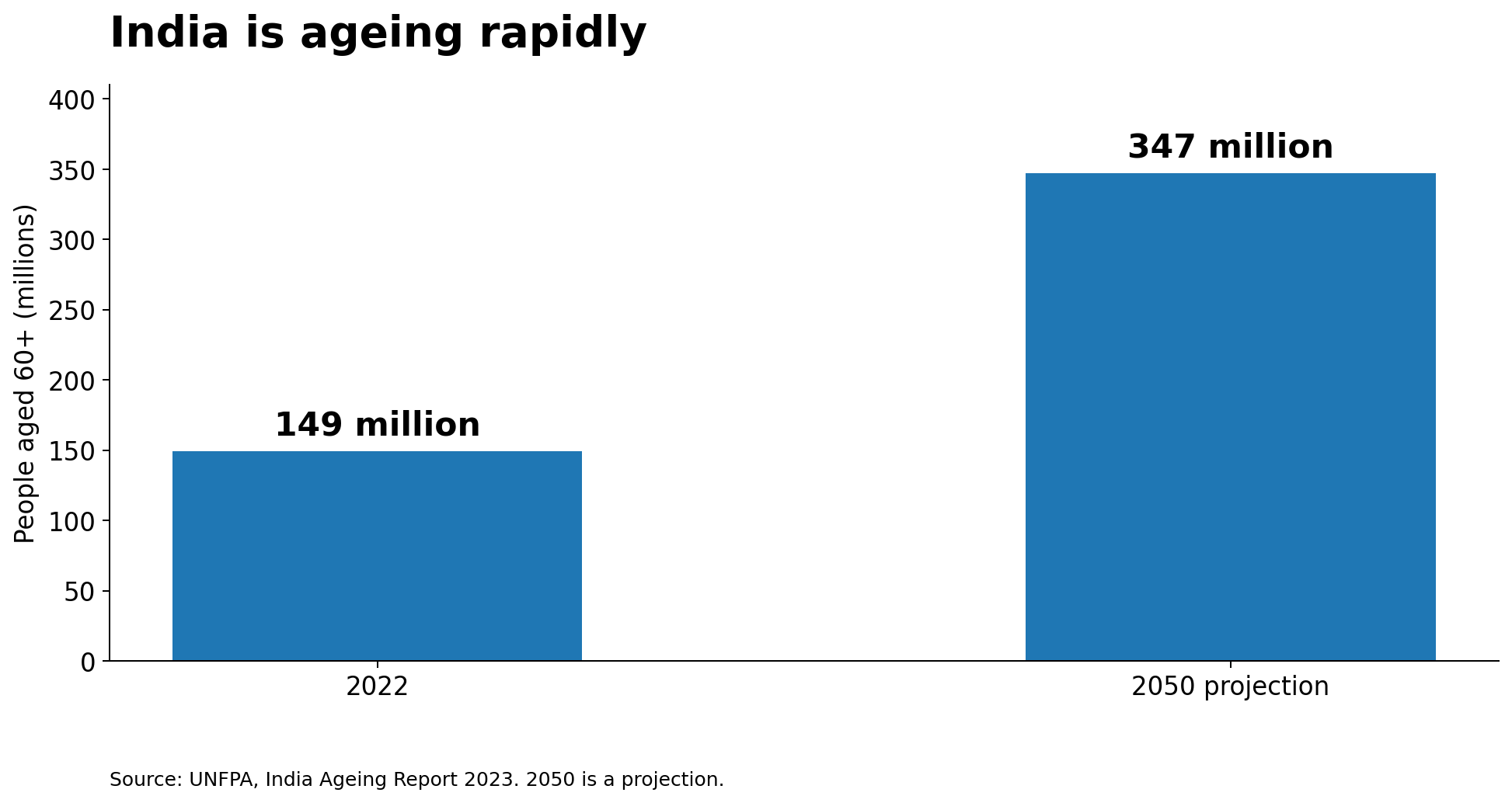
According to the United Nations Population Fund’s India Ageing Report 2023, India had approximately 149 million people aged 60 and above in 2022, representing 10.5% of the population.
By 2050, that figure is projected to reach 347 million, or 20.8% of India’s population.
The population aged 80 and above is projected to increase by approximately 279% between 2022 and 2050.
This is not a small demographic shift. It will change how India thinks about healthcare, housing, transportation, rehabilitation and independent living.
Source: UNFPA, India Ageing Report 2023
Now consider disability.
India’s Census 2011 recorded approximately 2.68 crore persons with disabilities, representing 2.21% of the population at the time.
But official disability counts and measures of everyday functional difficulties are not interchangeable. Different surveys use different definitions and identify different populations.
The Longitudinal Ageing Study in India (LASI), Wave 1, offers another way to understand the challenge.
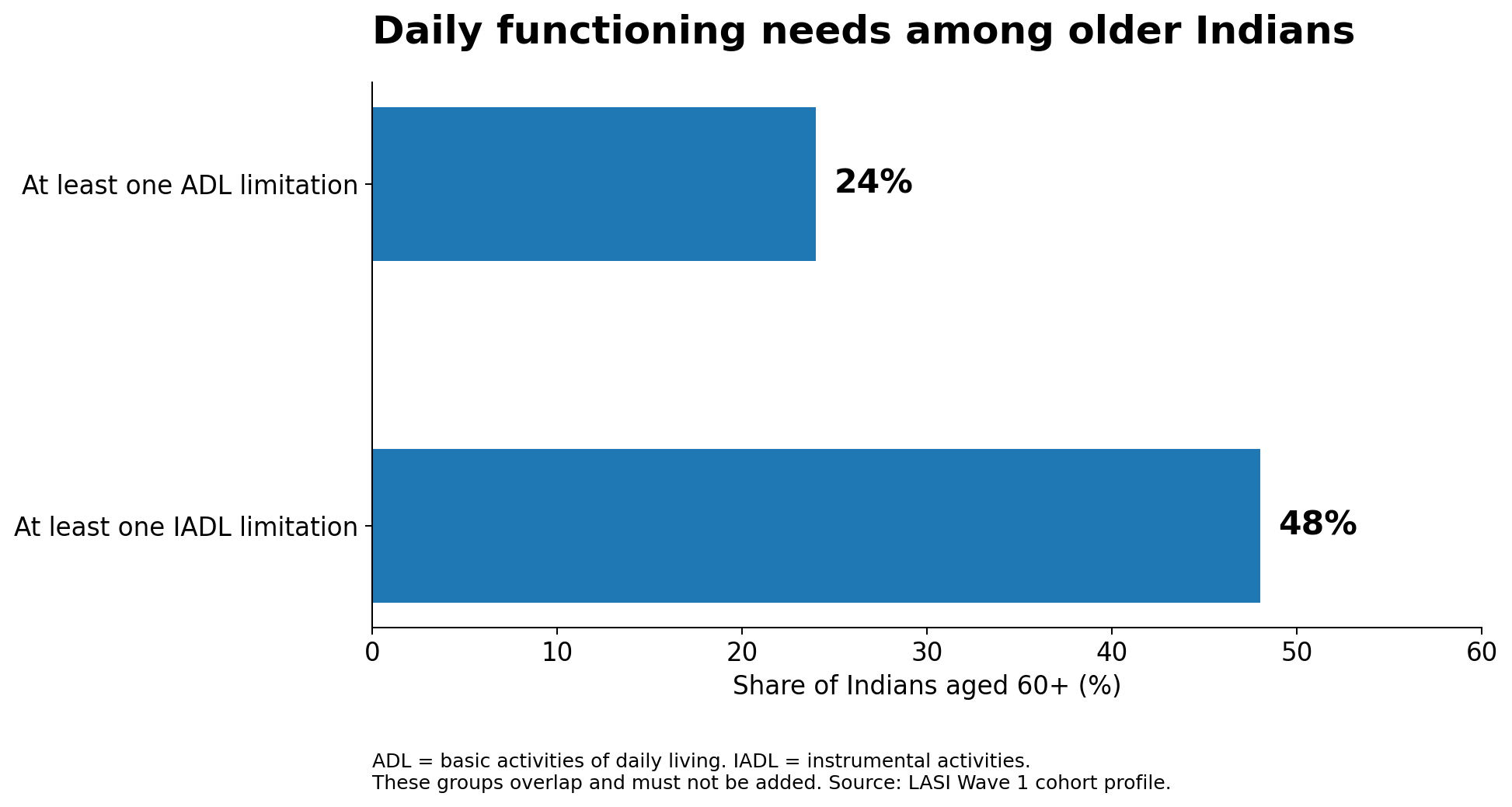
Among Indian adults aged 60 and above:
- 24% reported at least one limitation in activities of daily living (ADL), such as bathing, dressing, eating or getting in and out of bed.
- 48% reported at least one limitation in instrumental activities of daily living (IADL), which include tasks such as shopping, preparing meals or managing money.
These categories overlap and should not be added together. A functional limitation also does not automatically mean someone qualifies as a person with a disability under Indian law.
Nevertheless, the data makes something clear.
A significant proportion of older Indians experience difficulty with activities required for independent living.
Sources: Government of India, Persons with Disabilities Statistical Profile and LASI cohort profile, International Journal of Epidemiology.
 As the population ages, demand for rehabilitation, assistive products and support services is likely to rise.
The question is whether we are planning for that demand as a continuous need or responding only when someone reaches a crisis.
Aging with disability is different from aging into disability
There are two journeys we need to understand.
Aging with disability means growing older while living with a disability acquired earlier in life or present since birth.
Imagine someone who lost an arm at 25 and is now 65.
For 40 years, they may have adapted how they work, lift, carry, cook and perform countless everyday tasks.
Their body, routine and expectations at 65 may be different from what they were at 25.
Aging into disability means acquiring a disability later in life.
This may happen following a stroke, limb amputation, progressive health condition or another event that changes a person’s ability to perform daily activities.
Someone who has lived independently for 70 years may suddenly need to learn new ways of moving, communicating or caring for themselves.
These two groups have different experiences.
The first may be familiar with assistive technology but need their devices and routines to evolve.
The second may have to navigate an unfamiliar world of rehabilitation, equipment, accessibility and social adjustment.
Both need more than a one-time intervention.
They need a system that can respond as their lives change.
The challenge of funding disability support beyond employment
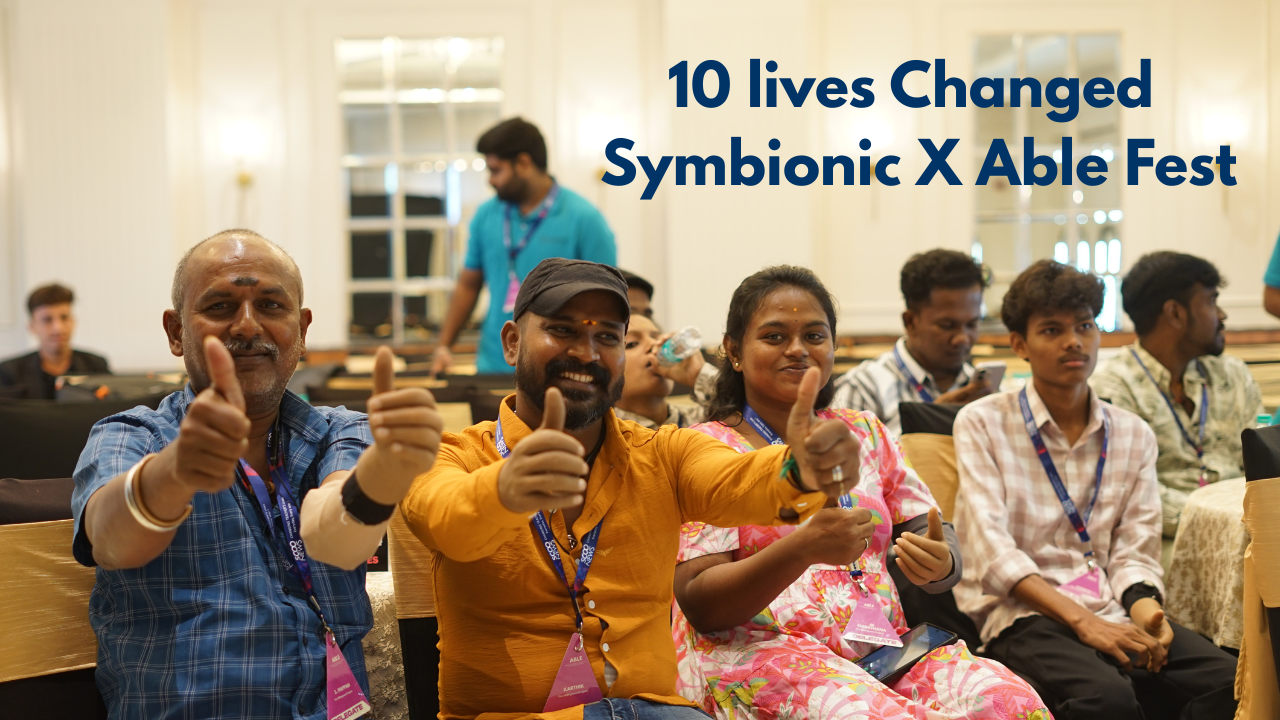
One issue I have observed while working in the disability-support ecosystem is how strongly we connect rehabilitation outcomes with livelihood.
When we approach CSR programs to support prosthetic fittings, an important part of the conversation is often about economic independence.
Will this person be able to return to work?
Will the prosthesis help them earn an income?
Will they be able to support their family?
These are meaningful measures of impact. For many younger beneficiaries, returning to employment can be life-changing.
But what happens when someone is 70?
What if they are retired?
What if their objective is not to earn more money, but to prepare a meal, dress without assistance, move around their home or spend time with their grandchildren?
How should we measure the value of assistive technology in their lives?
I believe this exposes an important gap in how we think about rehabilitation funding.
A program designed primarily around restoring livelihood may not adequately capture the needs of an older person whose immediate priority is independent living.
This does not mean that no schemes or organisations support older people. India has several relevant programs, including the Rashtriya Vayoshri Yojana.
But I believe we need many more funding models that place independence, participation, comfort and quality of life alongside employment as legitimate outcomes.
The value of a prosthesis should not be measured only by whether someone can return to work. It should also be measured by whether it helps them live the life they want.
A person does not become less deserving of rehabilitation because they have retired.
Why the most advanced prosthesis is not always the right one
Technology is often judged by how sophisticated it is.
More motors. More sensors. More movements. More features.
But in assistive technology, sophistication alone does not determine usefulness.
Consider an advanced upper-limb prosthesis.
It may offer complex functionality, but depending on its design, it may also involve greater weight, charging requirements, control complexity or maintenance demands.
For some users, those trade-offs are worthwhile.
For others, particularly those whose physical abilities or endurance have changed, they may create difficulties.
A person who could comfortably use a particular device at 35 may find the same device tiring at 70.
A task that once required a powerful grip may eventually require greater simplicity, comfort or ease of positioning.
And a person who previously used one type of prosthesis may later prefer a different solution.
This is not simply a theoretical concern.
A scoping review of upper-limb prosthesis abandonment identified comfort and function as recurring reasons people stopped using their devices. Weight, heat and perspiration were among persistent comfort-related concerns.
These findings matter because a technically impressive device that someone finds uncomfortable or impractical may not serve them well.
The best assistive technology is not necessarily the one that does the most. It is the one that best meets the user’s needs.
And those needs can change over a lifetime.
Source: Review of upper-limb prosthesis abandonment and device-use barriers
The physical cost of decades of adaptation
When someone loses a limb, other parts of the body often take on additional responsibilities.
A person with upper-limb loss may rely more heavily on their remaining arm, shoulder, neck or back to perform everyday tasks.
Over time, these adaptations can contribute to physical discomfort or overuse.
A 2019 national study of US veterans with major upper-limb amputations found that approximately 71% of participants with unilateral limb loss reported at least one musculoskeletal condition affecting their remaining arm. The study also identified substantial levels of neck and back pain, highlighting the importance of monitoring long-term physical health in people with upper-limb loss.The study also reported substantial rates of neck and back pain.
A Norwegian study identified musculoskeletal overuse syndromes in 6.1% to 24.2% of participants with major upper-limb amputations, depending on the diagnosis and criteria used.
The Norwegian researchers found no difference in pain prevalence between prosthesis wearers and non-wearers, so it would be incorrect to claim that simply wearing a prosthesis prevents these problems.
Sources: Resnik and colleagues, PLOS ONE, 2019 and Norwegian upper-limb amputation study.
These studies are not direct predictions of what will happen to every Indian prosthetic user as they age.
They do, however, reinforce the importance of long-term physical health in rehabilitation.
We should be asking how a person’s remaining limbs, joints, muscles and posture are affected across decades.
We should also be studying which interventions genuinely improve comfort and long-term functioning.
A prosthesis is not successful merely because someone can wear it on the day of fitting.
The more important question is whether the person can continue using it comfortably and meaningfully as their circumstances change.
Why one assistive device may not be enough
When we speak about prosthetic users, we often focus entirely on the missing limb.
But human independence does not depend on one body part or one product.
As people age, they may experience changes in mobility, vision, hearing, balance, strength or dexterity.
A prosthetic arm user may later benefit from a walking aid, adapted household equipment or other assistive products.
Someone who begins using a wheelchair may also require home modifications, transfer training or additional support.
This is why assistive technology needs to be understood as an ecosystem rather than an isolated product category.
The World Health Organization defines assistive technology broadly, covering products and related services that support mobility, hearing, vision, communication, cognition and self-care.
It also notes that many people using assistive technology use more than one product.
Source: WHO, Assistive Technology Fact Sheet
A person may need different technologies at different stages of life.
And in many cases, they may need guidance to identify which technologies are appropriate.
The goal should not be to keep someone using one particular device indefinitely.
The goal should be to help them maintain choice and independence as their needs change.
India has assistive technology schemes. But what happens after distribution?
India is not starting from zero.
There are government programs designed to improve access to assistive devices.
The Rights of Persons with Disabilities Act, 2016 provides an important rights-based framework for persons with disabilities.
The Assistance to Persons with Disabilities for Purchase/Fitting of Aids/Appliances (ADIP) Scheme supports eligible persons with disabilities in accessing assistive devices, including prostheses, orthoses, hearing aids and mobility devices.
According to the Department of Empowerment of Persons with Disabilities’ published guidance, the scheme provides full or partial assistance based on income, approved device costs and eligibility conditions.
There are also specific provisions for higher-end prostheses.
Source: Department of Empowerment of Persons with Disabilities, ADIP Scheme
The Rashtriya Vayoshri Yojana (RVY) is specifically intended to support eligible senior citizens experiencing age-related disabilities or infirmities.
Under the government’s published framework, eligible senior citizens with monthly income not exceeding ₹15,000 can receive specified physical aids and assisted-living devices.
These include products such as walking sticks, wheelchairs, hearing aids, spectacles and other approved items.
Source: Press Information Bureau, Ministry of Social Justice and Empowerment
These programs represent important public investments.
However, it is worth distinguishing funding for access to equipment from funding for all the support someone may need throughout their lifetime.
A prosthetic socket may eventually require refitting.
A component may wear out.
A user may develop new functional requirements.
A family may need training.
A person may require reassessment when their physical condition changes.
Some schemes include provisions for replacement or repeat assistance. It would therefore be inaccurate to describe every government intervention as a strictly one-time handout.
The larger question is whether follow-up, maintenance, rehabilitation and changing needs are sufficiently coordinated and funded.
Who is accountable for those requirements?
Who makes sure users know where to seek support?
Who pays when a person’s device is no longer appropriate?
These are the questions a long-term assistive-technology system needs to answer.
The global access gap will grow with ageing
The World Health Organization and UNICEF estimated in their 2022 Global Report on Assistive Technology that more than 2.5 billion people worldwide need at least one assistive product.
By 2050, that number is projected to reach approximately 3.5 billion.
In some low-income countries, only around 3% of people who need assistive products have access to them.
The report also found that about two-thirds of people with assistive products reported paying out of pocket.
Source: WHO and UNICEF, Global Report on Assistive Technology
These figures cover the full range of assistive technology, not just prostheses or people with formally recognised disabilities.
They also point to a problem that cannot be solved by manufacturing alone.
More devices are necessary.
But so are trained professionals, fitting services, local repair networks, financing mechanisms, awareness and continued support.
If we are serious about improving assistive-technology access, we need to invest in the systems that make those devices genuinely useful.
Community: The missing part of assistive technology
There is another aspect of disability support that technology alone cannot address.
Social acceptance.
Even today, some people who experience mobility loss feel uncomfortable or ashamed when they are advised to use a wheelchair.
For some, it may feel like admitting that their physical abilities have changed.
Similar emotions can arise around prostheses, hearing aids and other assistive devices.
These feelings deserve understanding, not judgment.
Research in India has identified stigma as one of the barriers people report when accessing assistive technology, although affordability, availability and practical access barriers are also important.
Source: Research on assistive technology access and barriers in India
I believe we need to fundamentally change how society understands assistive technology.
A wheelchair is not a symbol of failure.
A prosthesis is not a symbol of inadequacy.
A hearing aid is not something to hide.
These are tools that can help people participate in everyday life.
We need to make using assistive technology as normal as wearing spectacles.
And I believe communities can help us move towards that goal.
Imagine someone who has recently lost a limb being able to speak with another person who has lived with limb loss for 20 years.
Imagine an older person beginning to use a wheelchair being introduced to people who travel, work, exercise and participate in public life while using wheelchairs.
Imagine family members learning from other families about accessibility, rehabilitation and supporting independence.
These conversations can change how people perceive their own possibilities.
They can also make the experience of acquiring a disability less isolating.
Online and offline communities both matter
An online community could help people share experiences, learn about assistive technologies, find credible resources and connect with others facing similar challenges.
Offline communities could create opportunities to meet peers, participate in activities, try assistive devices and speak directly with rehabilitation professionals.
These communities should include people with different disabilities, ages and levels of experience.
They should also respect individual choices.
Not everyone will want to use a prosthesis. Not everyone will prefer the same rehabilitation pathway. Some people may choose different technologies or use no device for certain activities.
A supportive community should create options, not pressure people into a particular definition of independence.
It should also offer a way for manufacturers, clinicians, researchers and policymakers to listen to what people actually need.
This is an area where I believe the assistive-technology ecosystem has considerable room to grow.
A person should not have to navigate disability alone, and they should not have to start from zero every time their needs change.
What lifelong assistive-technology support could look like
I believe a more useful model would connect six elements.
1. Appropriate assessment and fitting
Start by understanding the person’s actual activities, physical abilities, living conditions and preferences.
The objective should be to identify appropriate technology, not simply distribute an available product.
2. Continued training and rehabilitation
Using assistive technology is often a learned skill.
Someone may need initial training, periodic guidance or additional rehabilitation as their activities and abilities change.
Training should be available when it is useful, rather than being treated only as part of the first fitting.
3. Scheduled follow-up and reassessment
Programs should make it easier for people to return for assessments.
Follow-up intervals should depend on clinical requirements, device type and individual circumstances rather than following one rigid schedule for everyone.
The purpose is to identify changing needs and address problems before they become prolonged barriers to device use.
4. Accessible maintenance and repair
A device that requires lengthy travel or expensive servicing can become difficult to maintain.
Local servicing capability, modular components, clear repair pathways and affordable replacement parts can make continued use more practical.
5. Adaptable technology and access to other devices
The system should make it easier for people to change or add functionality as their needs evolve.
It should also help users access other forms of assistive technology when appropriate.
The goal is not loyalty to a particular device.
It is continued independence and participation.
6. Community and peer support
People should have opportunities to learn from others, share experiences and access credible guidance throughout their journey.
Community networks can complement clinical and technical services.
They are not a substitute for professional assessment, but they can help address social, practical and emotional barriers that equipment alone cannot solve.
Together, these six elements offer a more complete way to think about long-term assistive technology.
Where Krea Adaptive fits into this thinking
At Symbionic, one of our central design principles is that assistive technology should adapt to people’s lives.
That philosophy shapes Krea Adaptive, our modular upper-limb prosthetic system, designed and assembled in Chennai.
Krea Adaptive uses a custom 3D-scanned socket and a Quick Disconnect wrist adapter that allows users to change compatible activity-specific attachments without tools.
The wrist can rotate through 360 degrees to help users position attachments for different tasks.
The system’s five publicly described attachments are:
- Krea Cosmetic: Designed for a natural appearance in everyday use.
- Krea Ride Assist: Designed to assist with gripping handlebars.
- Krea Gym Assist: Designed for exercise and training activities.
- Krea Swim Assist: Designed for swimming activities.
- Krea Eat Assist: Designed to assist with eating.
Users can select attachments according to their activities rather than needing every attachment at the beginning.
The system’s modular approach allows compatible functionality to be added or changed as requirements evolve.
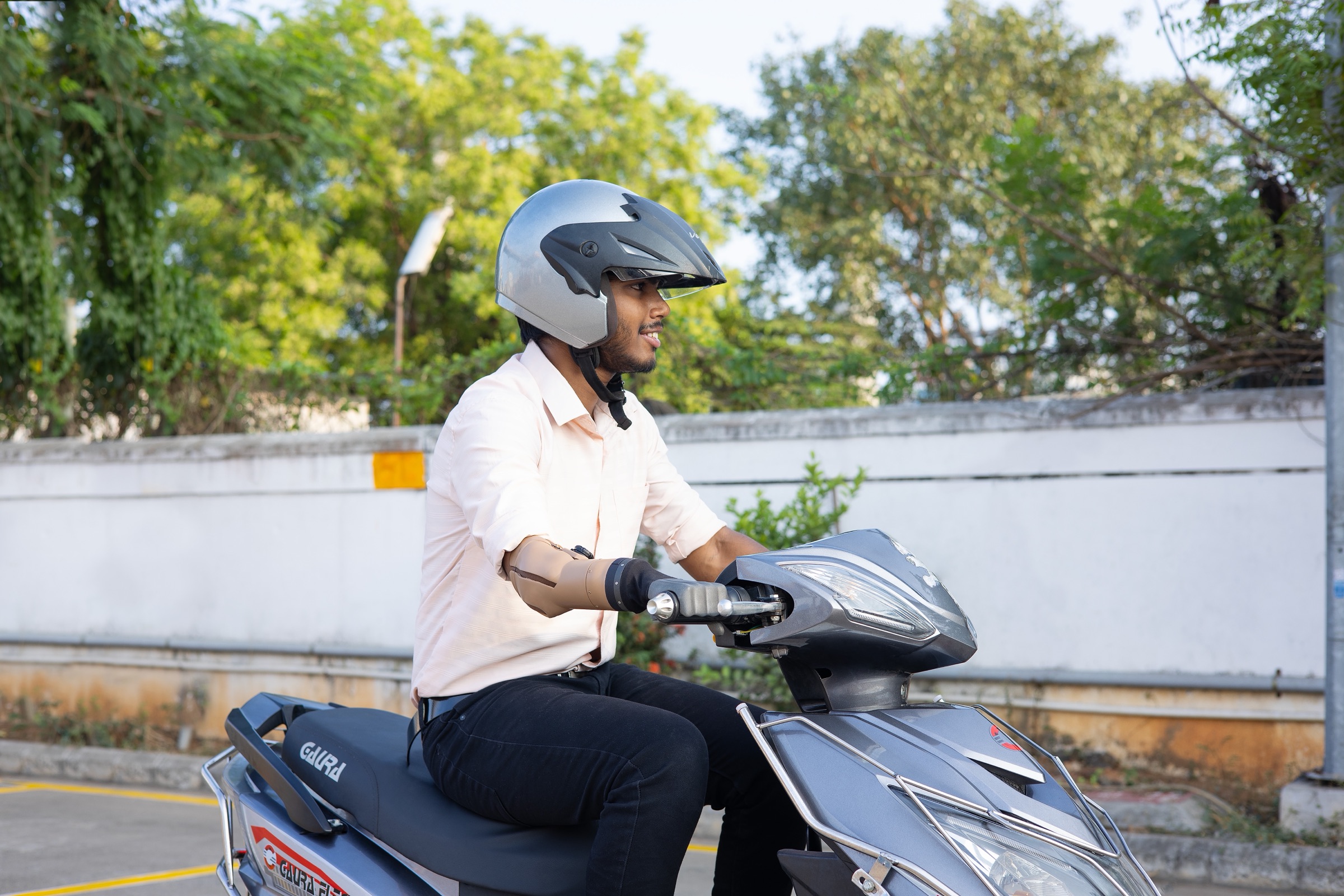 For us, this is about more than offering multiple attachments.
It represents a different way of approaching prosthetic design.
Instead of assuming one terminal device will serve every person in every activity, we want to give users options.
Weight, comfort, durability, ease of use and maintenance are also important parts of this approach.
We design for Indian conditions, where heat, dust, travel distances, affordability and access to servicing can influence the everyday practicality of a prosthetic system.
Our fitting process includes assessment, 3D scanning, socket production, adjustment, training and follow-up.
But Krea Adaptive is only one part of the broader challenge I am discussing here.
A modular prosthesis is not, by itself, a lifelong support system.
A genuine ecosystem would also need continuing clinical services, appropriate financing, access to other assistive technologies and community-led support.
That is the larger direction I believe the industry needs to pursue.
How should we measure success?
If we want to change assistive-technology programs, we also need to change how we measure their outcomes.
The number of devices distributed is an important operational metric.
But distribution alone does not tell us whether a product remains useful.
I believe programs should increasingly ask:
- Is the person still using the device after six months, one year and beyond?
- Is it comfortable and appropriate for their current activities?
- Have their physical or functional requirements changed?
- Can they obtain repairs, adjustments and training when needed?
- Do they have access to other assistive technologies if their needs expand?
- Do they feel confident using the device at home and in public?
- Does the technology support the activities and choices that matter to them?
These are proposed measures, not outcomes that every existing program currently tracks.
There is also an economic question worth studying.
Could planned maintenance, timely refitting and appropriate rehabilitation reduce certain downstream costs?
Could better support improve continued device use?
Could community-led programs make access and learning easier?
These are reasonable questions for research and program evaluation. The evidence should determine which interventions are effective and cost-efficient.
We should not assume that every proactive intervention automatically saves money.
But we should also recognise that independence, participation and quality of life have value beyond financial returns.
What CSR leaders, NGOs and policymakers can do now
India has an opportunity to build better support systems before the number of older people needing assistive technology grows even further.
I believe seven priorities deserve attention.
1. Fund independence, not just employability
CSR and rehabilitation programs should recognise everyday independence, participation and quality of life as meaningful outcomes, including for people who are retired or unable to work.
2. Budget for the full device lifecycle
Funding proposals should consider assessment, fitting, training, maintenance, follow-up and potential refitting, not merely initial distribution.
3. Support technology that can adapt
Design and procurement decisions should consider weight, comfort, usability, repairability and the ability to accommodate changing needs.
4. Connect ageing and disability services
Senior-care programs, rehabilitation centres, disability organisations and assistive-technology providers should work together more closely.
5. Invest in local service networks
Regional fitting and maintenance capabilities can reduce practical barriers for users who cannot easily travel long distances.
6. Build community-led support
Peer networks, local events, accessible information and moderated online communities can help people learn from one another and reduce isolation.
7. Measure long-term outcomes
Programs should track whether technology continues to meet the person’s needs, not only whether it was delivered.
These ideas require coordination across government, CSR funders, NGOs, manufacturers, clinicians, researchers and users themselves.
No single organisation can build the entire ecosystem.
But each can help make it more connected.
Frequently asked questions
What is the difference between aging with disability and aging into disability?
Aging with disability means growing older while living with a disability that began earlier in life. Aging into disability means acquiring a disability later in life. Both groups may need assistive technology, rehabilitation and support that changes over time.
Why might older people need different prosthetic devices?
Strength, endurance, skin condition, daily activities and other health factors may change with age. These changes can affect how a prosthesis fits, feels and functions. Device suitability should be reviewed according to individual needs.
Are advanced prosthetic arms always better?
No single prosthetic technology is best for everyone. Advanced functionality may be useful, but comfort, weight, ease of use, reliability and activity-specific requirements also matter.
What government schemes support assistive devices in India?
The ADIP Scheme provides support for eligible persons with disabilities, while Rashtriya Vayoshri Yojana supports eligible senior citizens with age-related impairments. Both have specific eligibility conditions and approved-device provisions.
How can CSR programs support older people with disabilities?
CSR programs can support assistive-device access, training, maintenance, refitting, rehabilitation, accessible services and community initiatives. Programs can also measure outcomes related to independent living and participation rather than employment alone.
Why does community matter in assistive technology?
Peer support can help people exchange practical knowledge, understand available options and feel more comfortable navigating disability. Community-led activities can complement professional rehabilitation and device services.
Conclusion: A device is a purchase. Support is a system.
India is preparing for an older population.
But we also need to prepare for an older population that will need more assistive technology, rehabilitation and continued support.
The challenge is not just to design better prostheses, wheelchairs, hearing aids or rehabilitation devices.
It is to build a system that continues to serve people as their lives change.
One that recognises independence beyond employment.
One that understands the importance of comfort and adaptability.
One that makes assistive technology accessible without unnecessary stigma.
And one that connects people with the technology, professionals and communities they need throughout their lives.
I believe we should build that system now, rather than waiting until millions more people need it.
A device is a purchase. Support is a system. India has funded the purchase. It is time to build the system.
At Symbionic, we want to contribute to that future through adaptable prosthetic technology and partnerships that place people’s long-term needs at the centre.
If you work in CSR, rehabilitation, assistive technology or public policy and are interested in building more sustainable support systems, connect with Symbionic.